The DPC Difference:
Direct Primary Care vs. Traditional Primary Care
Choosing how to manage your health often feels like picking
between “The Way It’s Always Been” and a “New Frontier.” If
you’ve been hearing the buzz about Direct Primary Care (DPC), you might
be wondering how it actually stacks up against the traditional insurance-based
model you’re used to. While both aim to keep you healthy, the experience of
getting there is night and day. Here is a side-by-side look at how these two
models compare.
1. The Clock: Time Spent with Your Provider
In a traditional clinic, your provider is often a “cog
in the machine,” seeing 25–30 patients a day to keep up with insurance
billing requirements.
- Traditional:
You wait 20 minutes in the lobby for a 10-minute “speed-dating”
session with your doctor. Most of that time is spent with them looking at
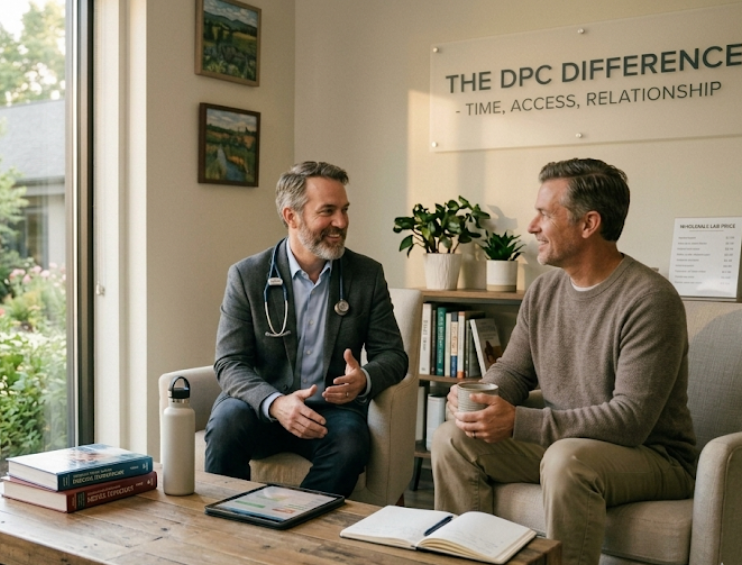
a computer screen to satisfy billing codes. - The DPC Difference: DPC providers limit their total patient list (usually
to a few hundred, not thousands). This means 30- to 60-minute
appointments are the standard. You have time to discuss your sleep,
your stress, and your long-term goals—not just your symptoms.
2. The Wallet: Predictability vs. Surprise
Traditional healthcare is famous for the “Surprise
Bill”—the one that arrives in your mailbox three weeks after your visit
because your insurance decided a specific lab wasn’t covered.
- Traditional:
You pay a monthly premium, then a co-pay at the door, and then wait for
the “Explanation of Benefits” to see what you actually owe. - The DPC Difference: You pay one flat monthly membership fee
(similar to a gym or Netflix). That’s it. No co-pays, no deductibles for
office visits, and no surprise invoices. If you need 5 visits this month
or zero, your price stays the same.
3. The Savings
What about health needs outside of just time with your provider?
- Traditional:
You’ll likely face deductibles, co-pays, and cost shares, not only for
your visit, but also for your medications, lab work, and imaging. These
can really add up depending on your insurance plan. - The DPC Difference: Many DPC providers offer their members wholesale
pricing on labs, prescriptions, and even on some imaging. That savings can
significantly offset membership fees.
4. The Access:
“See You in Three Weeks” vs. “See You Now”
Have you ever called your doctor with a sinus infection only
to be told the next available appointment is in 14 days?
- Traditional:
High patient volumes lead to massive backlogs. You often end up at an
Expensive Urgent Care center because your own doctor can’t squeeze you in. - The DPC Difference: Because the patient list is smaller, most DPC clinics
offer same-day or next-business-day appointments. Many also give
you direct access to your doctor via text or email for quick questions
that don’t even require a trip to the office.
5. The Bottom Line: Comparison Table

Which one is right for you?
- Traditional healthcare is built for the system.
- Direct Primary Care is built for the person.
If you are someone who manages a chronic condition, a parent who needs quick answers for a sick child, or a small business owner looking for predictable costs, the DPC model offers a level of care that the traditional system simply isn’t designed to provide. Keep the insurance plan for the “big” needs like hospital stays or surgeries, look to DPC for the rest.
Are you interested in learning more?
Call Lawrence Community Care at 269-241-2220 to set up a complimentary time to discuss your personal health needs and learn about our membership option.